
On this page
- What does a new gutter system include?
- How is a seamless gutter installed?
- What size gutters does a Mesquite house need?
- Which gutter material is best?
- Installation types
- Local conditions an installer should plan for
- What to ask an installer
- How an installation day usually goes
- Matching the system to the house
What does a new gutter system include?
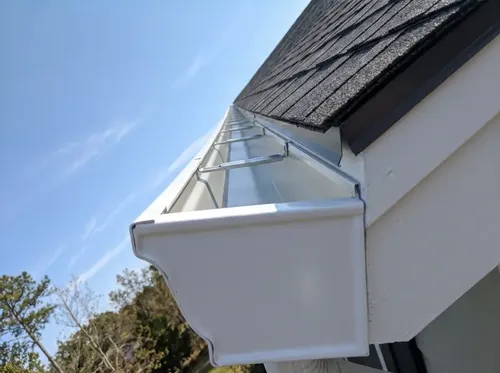
A gutter system runs from the roof edge to the place the water soaks in or drains away. A good quote names each part.
| Part | What it does | What to look for in a quote |
|---|---|---|
| Drip edge or gutter apron | Metal flashing that sends water into the gutter, not behind it | Whether it is there, or will be added |
| Fascia | The board the gutter fastens to | Probing for rot; replacement priced per foot |
| Gutter | The trough, usually K-style or half-round | Size (5 or 6 inch), metal, thickness (.027 or .032 inch aluminum) |
| Hidden hangers | Screw-in brackets inside the gutter | Spacing, usually 24 inches or closer |
| Miters | Corner joints | How they are sealed and riveted |
| End caps | Closures at the run ends | Sealed and crimped |
| Outlets | Holes where water leaves the gutter | Size matched to the downspout |
| Elbows | Bends that bring the downspout to the wall | Number per downspout |
| Downspouts | Vertical pipes, 2x3 or 3x4 inch | Count and size |
| Straps | Hold downspouts to the wall or brick | Two or more per downspout, with masonry anchors on brick |
| Extensions or drains | Carry water away from the slab | Length and where they end |
How is a seamless gutter installed?
- Measure. Every run is measured and each corner and outlet noted.
- Check the roof edge. The installer looks for a drip edge and probes the fascia and rafter tails for rot.
- Take down the old system. Spikes, ferrules, old hangers and downspouts come off; rotten wood is replaced.
- Form the gutter. A roll-forming machine on a trailer shapes aluminum coil into one continuous length for each run.
- Snap the pitch. A chalk line sets a fall of about a quarter inch per 10 feet toward each outlet.
- Cut outlets and hang. Outlets are cut, and the gutter is screwed through hidden hangers into the fascia.
- Miter and seal. Corners are mitered, riveted and sealed; end caps are crimped and sealed.
- Run the downspouts. Downspouts are strapped to the wall and finished with extensions or connected to a tested drain.
- Water test. A hose in each run shows whether water reaches the outlets and leaves the downspouts.
What size gutters does a Mesquite house need?
Mesquite's population went from 1,696 in 1950 to 67,053 in 1980, and much of the housing from those years is one-story brick ranches with long, low eaves and simple gable or hip roofs. On those, 5-inch gutters with enough downspouts usually work. The harder cases are two-story houses in the newer subdivisions, hip roofs where several planes empty to one corner, and any roof with valleys.
Dallas averages about 39 inches of precipitation a year, with May and October the wettest months, and spring storms deliver it in bursts. In 2015, DFW Airport recorded 16.96 inches in May alone. A gutter sized for a strong storm overflows far less often. See 5-inch vs 6-inch gutters.
| House | Typical size | Downspouts |
|---|---|---|
| 1950s to 1970s one-story brick ranch | 5-inch | 2x3 or 3x4, four to six |
| 1980s traditional with a hip roof | 5-inch, 6-inch on long rear runs | 3x4, six to eight |
| 1990s and 2000s two-story | 6-inch on most runs | 3x4, extra outlets near valleys |
| Historic farmhouse or homestead | 5 or 6-inch half-round | 3 or 4-inch round |
| Shop, barn or outbuilding | 6-inch K-style or box gutter | 3x4 or larger |
Which gutter material is best?
Aluminum is the default: light, rust-free, available in many colors and formed seamless on site. In hail country, ask for .032-inch coil. Copper suits historic houses and high-end accents. Galvanized and Galvalume steel resist dents better than thin aluminum but rust where scratched. Vinyl is cheap but softens in Mesquite's 100-degree summers and cracks in hard freezes.
Installation types
- Seamless gutters: one piece per run.
- 6-inch gutters: for large or steep roofs and long runs.
- Half-round gutters: for older and traditional-style houses.
- Copper gutters: for historic homes and accents.
- Aluminum gutters: the standard choice.
- Steel gutters: galvanized and Galvalume for dent resistance.
- Downspouts: sizing, placement and drainage.
Local conditions an installer should plan for
Hail. North Texas has some of the costliest hailstorms in the country. Thicker coil, sturdy downspouts and straps set into the brick help a system come through looking straight.
Clay soil. Mesquite's Blackland Prairie clay has a high shrink-swell property. Downspout placement and discharge matter as much as the gutter. See gutters and foundations on clay soil.
Brick. Most Mesquite houses are brick. Downspout straps need masonry anchors, and gutters often hang on a narrow fascia above the brick line.
Heat. Aluminum expands in summer heat over 100°F. Long runs need room to move at the corners.
What to ask an installer
- What size and thickness of gutter are you quoting, and why?
- How many downspouts, what size, and where will each one discharge?
- What hangers, at what spacing, and screwed into what?
- Will you probe the fascia, and how is rotten wood priced?
- Are you registered with the City of Mesquite, and can you show insurance?
See what gutters cost in Mesquite for price ranges.
How an installation day usually goes
- Measure and confirm. The installer checks each run against the quote, confirms colors and marks downspout positions.
- Remove the old system. Old gutters, spikes and downspouts come down, and the fascia is exposed.
- Repair the fascia. Soft or rotted boards are replaced and primed. This is the step that is priced separately, because no one knows the extent until the gutters are off.
- Fit drip edge where needed. A drip edge under the shingles keeps water from running behind the gutter.
- Form the gutters on site. A seamless machine on the trailer rolls each run from a coil to the exact length.
- Hang and pitch. Each run is hung on hidden hangers with a slight fall toward its outlet.
- Fit corners, end caps and outlets, sealed with gutter sealant and riveted.
- Hang the downspouts, strapped into the brick with masonry anchors, and fit extensions or connect drains.
- Water-test each run with a hose and clean up.
Most one-story Mesquite houses are done in a day. Larger two-story homes, or jobs with a lot of fascia work, can take longer.
Matching the system to the house
| House | Usual system |
|---|---|
| One-story brick ranch | 5-inch seamless aluminum, 2x3 or 3x4 downspouts |
| Two-story traditional | 5-inch front, 6-inch rear and below valleys, 3x4 downspouts |
| Large custom home | 6-inch throughout, more downspouts, sometimes copper on feature runs |
| Older or farmhouse-style house | Half-round, aluminum or copper |
| Retail or warehouse | Box gutters, scuppers and large downspouts |