
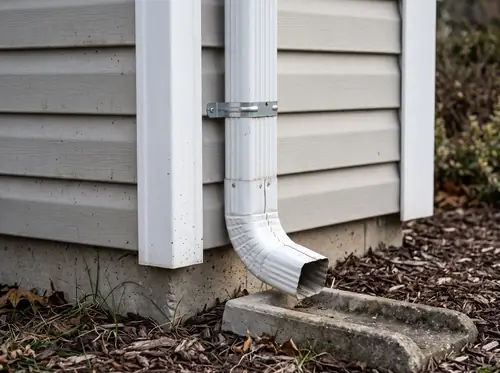
How much water a roof sheds
A rough rule is that an inch of rain on 1,000 square feet of roof produces a little over 600 gallons. A typical Mesquite ranch with 2,000 square feet of roof sheds more than 1,200 gallons in a one-inch storm. With Dallas averaging about 39 inches a year, that is tens of thousands of gallons a year, all of it collected by the gutters and sent through a handful of downspouts.
Where it goes next matters on Blackland Prairie clay, which swells when wet and shrinks when dry. Water concentrated at one corner of a slab is a foundation problem waiting to happen. See gutters and foundations on clay soil.
Options for the water
| Option | Works well when | Watch for |
|---|---|---|
| Splash block | Ground slopes away already | Only moves water a foot or two |
| Extension, 4 to 10 feet | Most houses | Mower damage, trip hazards |
| Flip-up extension | Over paths or beds | Must be put back down |
| Buried drain to the curb or a pop-up emitter | Small lots, finished yards | Clogs; needs a clean-out |
| Rain barrel | Gardens, beds | Fills fast; needs an overflow |
| Dry creek or swale | Larger lots | Must slope to a safe outlet |
The city's rules
Mesquite charges a monthly drainage fee, listed at $6.00 for residential customers, to fund its stormwater system. Under its stormwater rules, only rainwater may enter the storm system, so roof water is fine there, but nothing else should go with it. Downspouts should never be tied into the sanitary sewer.
Discharge should stay on your own lot or go to the street. Redirecting concentrated runoff onto a neighbor's yard can cause disputes and damage.
Rain barrels
A rain barrel captures some of the water for gardens. In a Mesquite storm, a 50 or 60-gallon barrel fills in minutes, so the overflow matters as much as the barrel. Run the overflow to an extension that carries it away from the slab. Keep the lid sealed against mosquitoes, and drain the barrel before a hard freeze.
Buried drain lines
On small lots, or where extensions are in the way, buried lines carry water to the curb or to a pop-up emitter in the yard. They work well if they are sized right, sloped, and have a clean-out. They fail when leaves and seeds wash down and clog them. Guards on the gutters help. See drain line repair.
Checking your discharge
In the next steady rain, walk around the house:
- Does water leave each downspout freely?
- Does it land at least several feet from the slab?
- Does the ground slope away from there?
- Is there pooling near the foundation, a walkway or the driveway?
Fix the worst spots first, usually corners where two roof planes drain to one downspout.